
Time in a Line, Time in a Circle
Christina Myers
2025
I measure time by the hostas now, and by the vining of the clematis and the return of the mint and sage. There are more scientific methods by which to count the passing of my life, of course: clocks and calendars, anniversaries and birthdays. Three months have passed when my multivitamin bottle is empty, a year when I get a postcard from the optometrist.
But these calculations are all a little too linear for me now, too much a reminder that life travels in one direction only, a thread which one day must come to its end.
Everything that exists, everything that you love, everyone you know, the clock and calendar whisper, must one day go away.
Hostas and mint, on the other hand, sing a gentler goodbye: we’re coming back, promise, just wait and see.
###
I spy the pointed tips of the hostas pushing through the dirt one day in early April and feel a sagging relief, like I’d been holding my breath without realizing. Every year, I am certain the hostas have died off.
This winter was too harsh, I tell myself. The west coast rains were too heavy or not heavy enough. The temperature dropped too far, for too long.
Or maybe I killed the hostas myself, greedy to multiply them, when I pulled the root balls out the prior autumn and used the machete to cut them into two or three chunks to be re-buried in new spots.
But then all of a sudden, overnight, when I am certain there is no hope, there they are again: tight spikes of green breaking through dark soil. Even the ones I hacked into small pieces come back, small baby hostas ready for their first season. Behind them, by days or weeks, come the tender twists of clematis, the furry mint, the fragrant sage, all the first signs of winter’s easing. Soon the blackberry bush stretches itself out, branches reaching further each year, and the raspberries and thimbleberries come back to life, large flat leaves soaking up sun so they’ll be ready to fruit late in the summer.
Everything returns, without my help, regardless of my worry and my watching.
###
I measure time by the moons now, too, which is not considered very scientific these days. People sniff at the moon: it’s fine to admire its beauty but it doesn’t have anything useful to tell us. The lunar cycle is both more precise and more logical than the one we use in our Google calendars, but we roll our eyes when someone mentions the full moon, the new moon, the waxing and the waning. It’s all a bit woo for the rational among us.
The moon? they’ll say. You think the moon affects us?
The moon can pull entire oceans this way and that, but it’s too much to believe it might do the same to you? The moon affects animal migration and birdsong, the timing of new growth come spring, the speed at which leaves unfurl and open, the opening of the roses on the vine. Plant your seeds at the right point in the moon cycle and they’ll be more likely to sprout.
The moon is more constant even than the seasons: it will never be altered by a pineapple express or El Nino or fossil fuels or AI. It might hide behind a cloud but I can tell you when the full moon will appear in the sky in March of 2056, or 2307, or any year, forever, with total accuracy. It keeps cycling, endless, silent, unchanged by our coming and going.
###
I noticed my hands for the first time this year. I’ve looked at them before, of course, and mostly bemoaned their manliness. Thick fingers, large palms. But I really saw them for the first time while washing sticky bread dough from between my fingers. As the last of the flour rinsed away, it was not my hands that were revealed, but my mother’s: the grooves around the knuckles etched deeper, the backs marked with small spots that I know will deepen and darken over time.
When I hold my hand up in front of my face, there’s a barely imperceptible shiver in it: familial tremors, it’s called. Nothing bad, but it runs in the family. My grandmother had it, and my aunts. My sister has it now, too, and when we are my mother’s age, the tremors will be impossible to hide, our hands like leaves fluttering in the wind each time we bring a slice of toast to our mouths.
I think of all the things these hands have done: held my newborn babies and linked fingers in the dark with lovers and typed a million words and cooked food for people I loved. My hands are their own measurement of time: the more they look like my mother’s, the less life I have remaining to hold babies and touch lovers and type words and cook food.
How did it go so fast? we ask, always surprised. The clock answers with its endless tick, tick, tick, a reminder that everything is already ending. But the moon looks on in silence, reliable in its cycle, coming and going and coming back again.
###
It’s fine to watch time unfold in a linear way—from left to right, start to finish, there and gone––when so much of it is still ahead of you. But I’m not young enough for that anymore. So, I pull on my sun hat, find the kneeling pad and bucket of garden tools, and go out to my yard to remember what the plants have to tell me instead.
My kids are no longer playing on a blanket nearby, my work is never interrupted by a hungry baby or by a toddler who has taken a tumble. The noisiness of early motherhood, of the first half of my life, for that matter, is gone. I work for hours in the quiet, pulling weeds from around the carrots, helping the jasmine twine along the lattice at the garden gate. The sun moves across the sky, warm and welcome in the spring, deep and intense in the middle of the summer, faded and cool come autumn. In winter, I wait, impatient to return to the yard, spending my time instead in nearby wooded trails where wild things have the same soothing message for me as the moon: yes, it’s true, everything will go away, but listen, everything will come back. Even you, my love.
I breathe this message in, as deep as I can. Our bodies will shrink and shrivel and one day we will stop breathing and loving and rushing from one day to the next, and our ashes will be thrown to the wind, to the sea, into the river, across the wide empty prairie, and we’ll come back in the dirt, in the vining clematis and the sage and in the cedars and salmonberries in the woods.
I want to tell my children all this but even as teenagers they’re still too young to appreciate the distinction between time in a line and time in a circle. They’ve only just begun to consider the notion of my mortality; their own is too far off yet to even imagine.
So I try to leave them clues to find later when they need it: I point out the crescent moon and the buds on the trees and the way the leaves skitter across the path. I don’t know how much of this they'll remember. Maybe hardly any at all.
But I hope when the times comes, when I seem to be gone from them, they will know to look for me where they can still find me: in the hostas that return each spring, no matter how hard the winter has been, and in the blackberries that feed the birds each August, and in the silent silvery cycles of the moon in the endless night sky.
Christina delivered a reading of this piece during the Silence panel at the 2025 Fraser Valley Writers Festival.
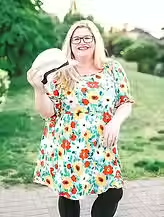
Christina Myers is a freelance writer and editor, a former journalist, and the author of Halfway Home: Thoughts from Midlife (House of Anansi, 2024) and The List of Last Chances (Caitlin Press, 2021). She has been the editor of two non-fiction anthologies, the second of which—Beyond Blue—is forthcoming this October. She was longlisted for the Leacock Medal, shortlisted for the Fred Kerner book prize, and won the 2023 Canadian Book Club Award in the fiction category. She teaches fiction and non-fiction through SFU's creative writing continuing studies department, leads workshops and seminars for a variety of literary organizations. Find her online at www.cmyers.ca.